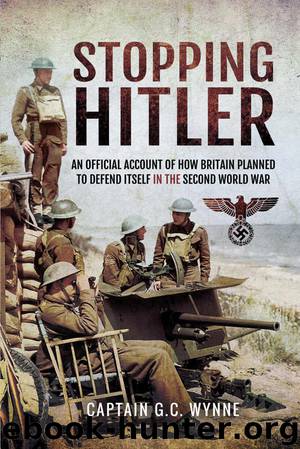
Stopping Hitler: An Official Account of How Britain Planned to Defend Itself in the Second World War by Captain Graeme Chamley Wynne
Author:Captain Graeme Chamley Wynne [Chamley Wynne , Captain Graeme]
Language: eng
Format: azw3
Publisher: Frontline Books
Published: 2017-02-28T05:00:00+00:00
Appendix VII
Chiefs of Staff Review of the Prospects of Invasion After the Fall of France
The object of this paper is to investigate the means whereby we could continue to fight single-handed if French resistance were to collapse completely, involving the loss of a substantial proportion of the British Expeditionary Force, and the French Government were to make terms with Germany. The assumptions we have made are contained in Appendix A of the Annex. Of these the two most important are that:
(i) United States of America is willing to give us full economic and financial support, without which we do not think we could continue the war with any chance of success.
(ii) Italy has intervened against us.
2. In particular we have asked ourselves two questions: (a) Could the United Kingdom hold out until assistance from the Empire and America made itself felt? And (b) Could we ultimately bring sufficient economic pressure to bear on Germany to ensure her defeat?
We summarise our conclusions and recommendations below. As regards the latter there are a large number of measures which we consider should be carried out at once irrespective of whether a French collapse is or is not likely.
CONCLUSIONS
3. There are three ways in which Germany might break down the resistance of the United Kingdom – unrestricted air attack aimed at breaking public morale, starvation of the country by attack on shipping and ports, and occupation by invasion.
Air Factor
4. The vital fact is that our ability to avoid defeat will depend on three factors:
(a) Whether the morale of our people will withstand the strain of air bombardment;
(b) Whether it will be possible to import the absolute essential of commodities necessary to sustain life and to keep our war industries in action;
(c) Our capacity to resist invasion.
All of these depend primarily on whether our fighter defences will be able to reduce the scale of attack to reasonable bounds. This will necessarily mean the replacement of casualties in personnel and aircraft on a substantial scale. Our capacity to resist invasion may, however, depend also to a great extent on the maintenance of an effective air striking force.
These factors cannot be assessed with certainty, and it is impossible to say whether or not the United Kingdom could hold out in all circumstances. We think there are good grounds for the belief that the British people will endure the greatest strain, if they realise – as they are beginning to do – that the existence of the Empire is at stake. We must concentrate our energies primarily on the production of fighter aircraft and crews, and the defence of those factories essential to fighter production should have priority. At the same time it is clear that we cannot afford to neglect our bomber force or to expend it on operations that are not of first importance.
Civil Defence
5. As long as the present quasi-peacetime organisation continues, it is unlikely that this country can hold out.
The present Home Security Organisation was constituted to deal with air attack only by aircraft
Download
This site does not store any files on its server. We only index and link to content provided by other sites. Please contact the content providers to delete copyright contents if any and email us, we'll remove relevant links or contents immediately.
| Africa | Americas |
| Arctic & Antarctica | Asia |
| Australia & Oceania | Europe |
| Middle East | Russia |
| United States | World |
| Ancient Civilizations | Military |
| Historical Study & Educational Resources |
The Radium Girls by Kate Moore(12183)
100 Deadly Skills by Clint Emerson(5023)
Rise and Kill First by Ronen Bergman(4901)
The Templars by Dan Jones(4796)
The Doomsday Machine by Daniel Ellsberg(4623)
The Rape of Nanking by Iris Chang(4324)
Killing England by Bill O'Reilly(4108)
Stalin by Stephen Kotkin(4070)
Hitler in Los Angeles by Steven J. Ross(4016)
12 Strong by Doug Stanton(3632)
Hitler's Monsters by Eric Kurlander(3466)
The Code Book by Simon Singh(3323)
Blood and Sand by Alex Von Tunzelmann(3299)
Darkest Hour by Anthony McCarten(3223)
The Art of War Visualized by Jessica Hagy(3098)
Hitler's Flying Saucers: A Guide to German Flying Discs of the Second World War by Stevens Henry(2815)
Babylon's Ark by Lawrence Anthony(2795)
Tobruk by Peter Fitzsimons(2622)
The Second World Wars by Victor Davis Hanson(2586)
